
Putnam County Deed Records and What They Show
Deeds answer one question: who owns a parcel. Assessment rolls, tax bills, GIS maps, and municipal approvals each answer a different one. In Putnam County, the clean way through is the SBL parcel number. Thread it through every property records source you touch. Then confirm anything time-sensitive with the office holding the original record.
| Deed Type | What It Does | Common Use |
|---|---|---|
| Warranty deed | verified Putnam County source information | verified Putnam County source information |
| Quitclaim deed | verified Putnam County source information | verified Putnam County source information |
| Grant / special warranty | verified Putnam County source information | verified Putnam County source information |
| Trustee / executor deed | verified Putnam County source information | verified Putnam County source information |
| Tax deed | verified Putnam County source information | verified Putnam County source information |
A Putnam County deed tells you who holds title. It does not tell you the assessed value, the tax bill, or the zoning. Those live with the assessor, Finance, and the towns. One habit prevents most mix-ups: carry the SBL parcel number from source to source, and verify dated facts with the custodian of the original deed, roll, or map.
The Putnam County Grantor-Grantee Index
Ownership, assessment, taxation, mapping, and municipal approvals all live in separate official records in Putnam County. Match the SBL parcel number across them. Confirm time-sensitive facts with the office that holds the original record.
- Follow the official portal and preserve the parcel number and source date for the next record check.
- Follow the official portal and preserve the parcel number and source date for the next record check.
- Follow the official portal and preserve the parcel number and source date for the next record check.
- Follow the official portal and preserve the parcel number and source date for the next record check.
- Grantor
- verified Putnam County source information
- Grantee
- verified Putnam County source information
- Chain of title
- verified Putnam County source information
- Book/Page vs Instrument #
- verified Putnam County source information
Getting a Copy of a Putnam County Deed
Copies come in two flavors: plain and certified. Each has a price set by the Clerk. Know which one you need before you pay. A title company usually wants certified; casual research rarely does. Whatever you order, cite it fully, with the parcel number, book and page, and recording date, so the deed can be found again.
Recorded, not guaranteed. Public records support lawful property research and due diligence, but they do not authorize harassment, intimidation, or harm; verify important conclusions with the record custodian.
Putnam County SearchIQS Land Records
The county-linked SearchIQS entry is the official land-record route for Putnam County deeds and related instruments.
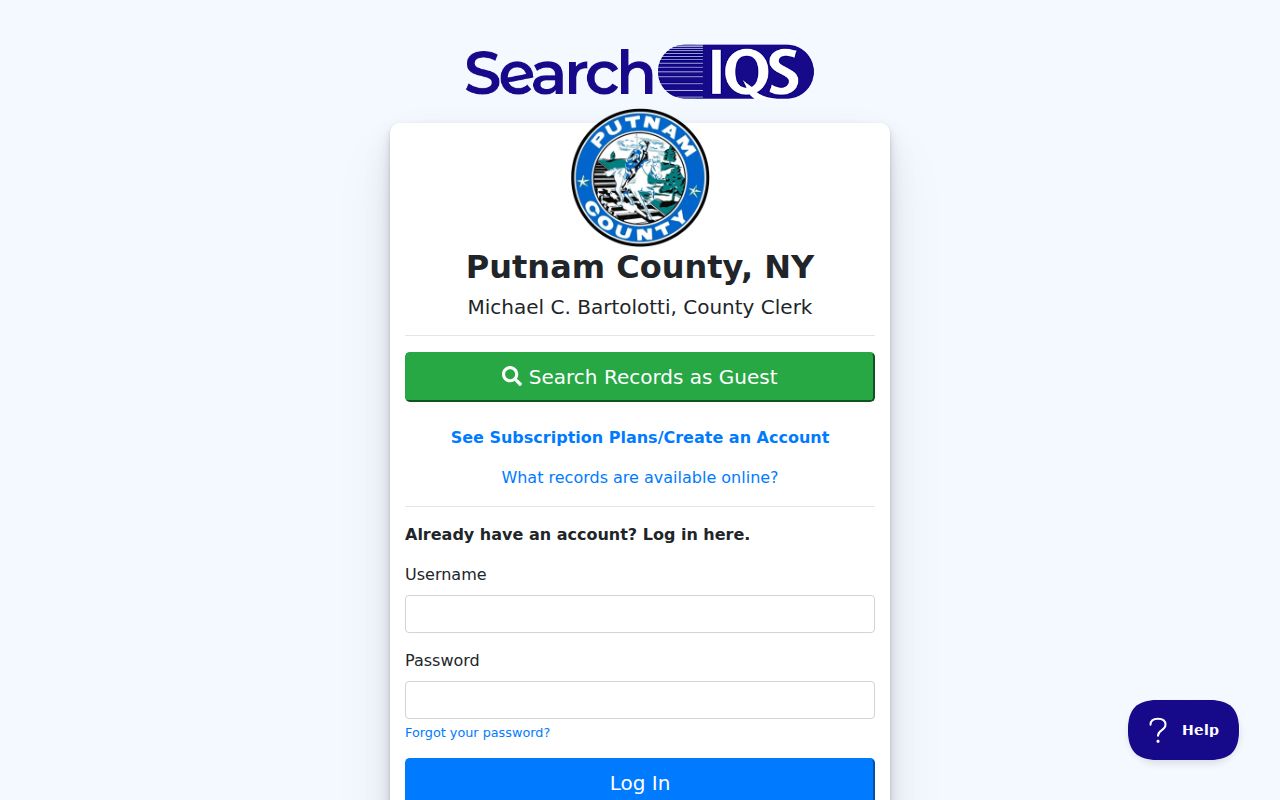
The SearchIQS landing page asks you to confirm the county before a guest or account search begins.
Coverage and Cost Clues in Putnam County Deed Records
SearchIQS draws a sharp line between index coverage and image coverage. The Putnam County deed index and its images both begin on July 3, 1972. Current land records start January 1, 1976. The historic grantor and grantee index stretches from 1812 through 1972. Deed record books A through 99 carry both indexing and images. Maps reach back to 1847. Other document classes have their own cutoff dates. An empty image field never proves an instrument went unrecorded.
Write down each result as a citation. Include grantor, grantee, instrument type, execution date, and recording date. Add the book and page or document number and the municipality. Note any linked map or prior instrument. The County Clerk allows public viewing. The county's own fee schedule puts a certified deed copy at four dollars. Each page costs fifty cents more. SearchIQS account and image charges are separate vendor costs. Ask the Clerk which form of copy you need. Settle that before paying for anything beyond an index check.
The free fraud alert takes an email and up to ten individual or company names. It flags a new name match. It is not an identity check. The Clerk warns that two people sharing a name can trigger an alert. For older deeds, research shifts to the Records Center or the County Historian. The Historian's catalog holds deeds and indentures from 1791, older indexes, mortgage material, historic title searches, assessments, and sheriff sales.
Source Notes for Putnam County Records
Keep your lookup honest. Record the office, the portal, and the search key. Also note the record date and the date you accessed it. An address is only a starting point; the SBL is the stronger cross-system key. Check name spellings and entity forms carefully. An index entry points to a source document but never replaces it. A parcel map gives geographic context, not a surveyed line. An assessment states a value for one roll year. It is not a current opinion of sale price. A tax screen shows one bill or payment status, not the full title history. These distinctions keep Putnam County property records research clear and reproducible.
When an online result runs thin, call the named custodian with a narrow request. List the municipality, address, SBL, record class, and date span. Bring recorded-instrument questions to the County Clerk. Ask Real Property or the town assessor about rolls and maps. Take county tax matters to Finance. Bring permits and zoning to the relevant town or village. Verify any consequential conclusion against the original record itself.
Document Classes Alongside Putnam County Deeds
A Putnam County deed chain rarely holds deeds alone. SearchIQS indexes mortgages, satisfactions, liens, judgments, maps, and notices of pendency too. Each class carries its own image cutoff. A mortgage secures a debt. A satisfaction releases it. A notice of pendency warns that litigation may affect the real property, but it is not a judgment on its own. Before you treat any index hit as a live burden, open the instrument itself and read any linked discharge.
Cite the deed result carefully. Putnam County property records reward precision here: note the grantor, grantee, deed type, execution date, recording date, municipality, book and page or document number, consideration when shown, legal description, and the prior-deed reference. Check the description against the parcel. Still, never swap deed wording for GIS shorthand. Recorded maps going back to 1847 can tie a subdivision or lot reference to the geometry you see today.
Older ground demands a different method in Putnam County. Deed images and index data online begin in July 1972. The grantor and grantee index, though, spans 1812 through 1972, and books A through 99 hold indexed images. County archive holdings reach further still: deeds and indentures from 1791, older mortgage and owner indexes, historical title searches, assessments, and sheriff-sale material. When a chain touches those series, move from the web to the record room or the county historian.
Match the copy to the purpose. For preliminary work, public viewing plus an index citation may suffice. The county warning lists a certified deed at four dollars plus fifty cents per page, and vendor subscription and download charges stay separate. Certification proves the copy came from the custodian. It does not insure title or settle an unrecorded claim against the parcel.
Corrections and Certified Putnam County Deed Copies
An index transcription can drift from the recorded page. In Putnam County deed records, always check names, dates, and document types against the image or an official copy before trusting the index entry. If the instrument is right but the index looks wrong, contact the County Clerk with the document number and the exact discrepancy. If the recorded instrument itself needs a legal correction, do not edit the chain informally or assume a fresh filing is routine. A New York real-property attorney can advise on the proper corrective instrument. A certified copy authenticates the custodian's record. It cannot cure a defective deed. Nor can it replace title review of the parcel.